Acoustics: A Softer Soundtrack
Small rooms amplify early reflections and muddy whispered dialogue. Treat reflection points with slimline joinery panels and everyday soft furnishings so you hear every word at lower volumes.
Why Small Rooms Blur Film Dialogue
In a compact room under 3.5 metres wide, sound leaving your centre and front left/right speakers hits the bare plasterboard side walls, hard timber floor, and rear wall behind your sofa in less than 6 milliseconds. Because those reflected waves arrive at your ears almost simultaneously with the direct sound from the speaker, your brain cannot separate them—resulting in comb filtering, harsh sibilance, and muffled speech.
The common mistake is turning the volume up, which only excites room modes between 50 Hz and 160 Hz and annoys people in the next room. By bringing your room's mid-band reverberation time (RT60) down into the 0.28 to 0.38 second range using 50 mm architectural panels and strategic joinery, whispered dialogue stays crisp even during late-night viewing at 62 dB SPL.
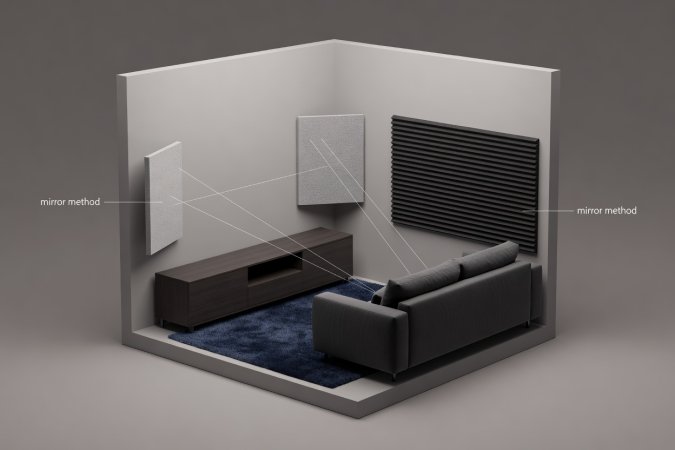
Acoustic Ray Path Schematic: Treating the two side-wall mirror points, the floor bounce path, and the rear head-height zone removes 70% of early comb-filtering reflections while taking less than 65 mm of wall depth.
Four Priority Reflection Zones
-
01
Rear Head-Height Absorber (Critical when Sofa touches Wall)
When your ears sit within 250 mm of the back wall, install a 50 mm mineral wool panel (60 kg/m³) with a 15 mm rear air gap directly behind the sofa backrest.
-
02
Side-Wall Mirror Points
Have a partner slide a handheld mirror along the side wall at ear height (960 mm). Wherever you see the front speakers reflected in the mirror from your seat, hang a 600 mm × 1200 mm absorber or 300 gsm velvet thermal curtain.
-
03
Floor Bounce Suppression
Place a dense wool rug (minimum 2800 g/m²) over a 10 mm vulcanised felt underlay across the 1.8 metres between the media cabinet and the sofa.
Living-Room Friendly Acoustic Joinery
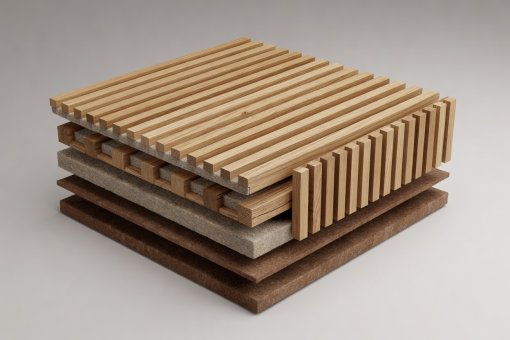
You do not need charcoal egg-crate studio foam glued to your walls—in fact, thin open-cell urethane foam only absorbs treble above 2.5 kHz, leaving the room sounding dull and boomy. Choose architectural treatments that read as warm interior joinery.
-
J1
Batten-Mounted Timber Slat & PET Felt Walls
Standard 21 mm acoustic slat panels mounted flat on plasterboard reach an NRC of roughly 0.55. Screw them onto 38 mm horizontal timber battens infilled with recycled polyester wool and absorption jumps to NRC 0.85 down to 250 Hz.
-
J2
Staggered Bookcase Diffusion
A floor-to-ceiling bookcase along a side or rear wall acts as a natural quadratic phase diffuser when you pull books forward and backward to varying depths (40 mm to 160 mm variance) rather than aligning every spine flush.
-
J3
Chamfered Corner Bass Traps
Triangular corner traps with a 250 mm face straddle the ceiling-wall or wall-wall junction where bass pressure peaks, using dead corner air without stealing walkable floor space.
Neighbour Isolation vs. Room Treatment
Keep the distinction clear: acoustic panels inside the room improve clarity so you can listen comfortably at 6 dB lower volume, while isolation stops low-frequency structural vibration from travelling through party walls and floorboards.
-
I1
Elastomeric Subwoofer Decoupling Feet
Never sit a subwoofer cabinet directly on suspended timber floorboards. Fit tuned Sorbothane or spring-elastomer isolation pucks underneath to prevent the floor joists from acting as a giant drum skin.
-
I2
Near-Field Tactile Or Under-Sofa Bass
Placing a compact sealed 8-inch subwoofer immediately beside or behind the sofa reduces the distance sound travels by 60%, giving you visceral low-end impact with a quarter of the amplifier output required from across the room.
-
I3
Acoustic Perimeter Door Seals
Sound leaks wherever air leaks. Adding self-adhesive silicone brush seals around the door rebate and an automatic drop-down threshold seal cuts hallway sound bleed by up to 9 dB.
Acoustic Treatment Performance & Depth Comparison
| Treatment Element | Installed Wall Depth | Effective Frequency Band | Typical NRC Rating | Primary Benefit in Small Rooms |
|---|---|---|---|---|
| 50 mm Fabric-Wrapped Rockwool + 15 mm Air Gap | 65 mm | 200 Hz – 16 kHz | 0.95 | Eliminates rear-wall slap behind sofa |
| Timber Slat Panel on 38 mm Infilled Battens | 59 mm | 250 Hz – 12 kHz | 0.85 | Warm joinery look for front or side walls |
| Double-Layered 320 gsm Velvet Window Drapery | 80 mm (pleated) | 500 Hz – 16 kHz | 0.65 | Stops glass glare and high-frequency ring |
| Irregular Bookcase (Varied Spine Depths) | 280 mm (existing shelf) | 600 Hz – 4 kHz scattering | Diffusive | Keeps small room sounding wide and lively |